P-Protect Review (2026): Ingredients, Price, and What the Research Says
P-Protect is a skin patch, not a capsule, sold as a prostate health support formula. Here is what the pouch claims, what we could not verify, what it costs and who it may suit.
Reader-supported: if you buy through links on this page, we may earn a commission at no extra cost to you. It never changes what we write. How we research.
In this article
P-Protect (often searched as "P Protect") is sold as a prostate health support formula for men, but it doesn't come as a capsule. It's a skin patch. That one detail changes most of the questions worth asking before you buy, from what's actually in it to how much of it reaches your bloodstream.
This review is based on the product's pouch, the official order page and its policies at the time of writing, plus published research on skin patches and on the ingredients most often used for prostate support. We haven't run our own tests, and nothing here is medical advice. Please read our medical disclaimer.
Key takeaways
- P-Protect is a transdermal (skin) patch. Each pouch holds 10 patches and is sold as a one-month pack.
- The pouch says the formula is "naturally formulated," "supports healthy circulation" and "helps urinary comfort."
- At the time of writing, neither the pouch artwork nor the official order page lists the ingredients or their amounts.
- We found no published clinical studies on P-Protect itself.
- Prices at the time of writing run from $79 per pack (2 packs) down to $49 per pack (6 packs), with a 60-day money-back guarantee.
- It may suit men who have already had their symptoms checked by a doctor and want a pill-free option, as long as they accept the evidence gaps.
What is P-Protect?
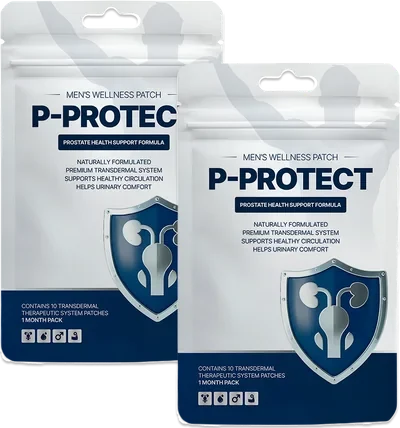
P-Protect is a men's wellness patch marketed for prostate health. The front of the pouch reads "Men's Wellness Patch," "Prostate Health Support Formula," "Naturally Formulated," "Premium Transdermal System," "Supports Healthy Circulation" and "Helps Urinary Comfort." Each zip-top pouch "contains 10 transdermal therapeutic system patches" and is labeled as a one-month pack.
On its order page, the seller calls P-Protect "The #1 Men's Wellness Support Formula" and says it is designed to help maintain natural functions related to men's overall wellness and daily rhythm, "supporting a sense of energy, balance, and confidence throughout the day."
Those are modest claims. The pouch doesn't promise to change the size of the prostate or to replace medicine, and the site carries the standard notice that its statements haven't been evaluated by the FDA. That restraint is a good sign. The bigger issue is what the pouch leaves out.
What's in P-Protect? The ingredient question
Here is the honest answer: at the time of writing, we could not find a published ingredient list for P-Protect. The pouch artwork shows claims, not a formula, and the official order page doesn't list ingredients or amounts either. Directions for use aren't published online.
| What the pouch or seller says | What we could verify | What it means for you |
|---|---|---|
| "Prostate Health Support Formula" | No ingredient list or amounts published | You can't compare the dose with published studies |
| "Naturally Formulated" | No plant names disclosed | Ask support for the full list before ordering, especially if you have allergies |
| "Premium Transdermal System" | It's a skin patch, 10 per pouch | Skin delivery has its own limits (see below) |
| "Supports Healthy Circulation" | No product-specific study found | Read it as a manufacturer claim |
| "Helps Urinary Comfort" | No product-specific study found | Read it as a manufacturer claim |
There's a regulatory reason the familiar label may be missing. The FDA explains that dietary supplements must be swallowed, so topical products are not supplements. The Supplement Facts panel, which lists each dietary ingredient and its amount per serving, is a dietary supplement requirement. A skin patch sits outside that category, so don't assume you'll get the same kind of label you'd see on a bottle of capsules.
If you're interested, the simplest step is to email the support team and ask for the complete ingredient list, with amounts per patch, before you order. A clear answer tells you a lot. So does no answer.
How the usual prostate ingredients compare
Most prostate formulas sold as capsules draw from the same short list of ingredients. We don't know whether P-Protect contains any of them. Here's where the evidence stands for the oral forms, so you know what to look for if the seller shares a list.
| Ingredient | What studies of oral forms found | Evidence |
|---|---|---|
| Saw palmetto | A 2023 Cochrane review of 27 studies found little to no benefit for urinary symptoms | Weak |
| Beta-sitosterol | Four short trials (519 men) showed better symptom scores and urine flow | Limited |
| Pygeum | 18 small, short trials suggested improvement, including 19% less nighttime urination | Limited |
Our guide on how to choose a prostate supplement covers these and other ingredients in more depth, with doses and caveats.
Do skin patches work for this kind of formula?
Patches are a proven way to deliver some medicines. But the skin is built to keep things out, and only certain molecules get through well.
- Size matters. Dermatology researchers have argued that a compound generally needs a molecular weight under about 500 daltons to pass the skin's outer layer, and that all known drugs used in transdermal systems fall under that limit.
- Patches suit a narrow group of drugs. A review in Nature Biotechnology described first-generation patches as best suited to "small, lipophilic, low-dose drugs."
- Nutrient patches have a weak track record so far. In one study of gastric bypass patients, people who used a multivitamin patch for a year were more likely to be low in vitamin D than those who took pills (81% vs 36%). A 2021 review concluded that evidence for nutrient patches in humans is still limited.
None of this proves P-Protect doesn't work. It means the patch format adds a question that capsules don't have: does enough of the formula get through the skin? Without a published ingredient list or a study on the product, that question stays open.
Skin reactions are the other point to know. A review of contact dermatitis from transdermal systems notes that a patch combines an adhesive, the active ingredients and often absorption enhancers, and any of the three can cause irritation or an allergic rash. Wearing patches repeatedly on the same spot raises the odds.
How to use P-Protect
The seller doesn't publish directions online. With 10 patches in a one-month pack, you won't be applying a new one every day, but placement and wear time should come from the directions inside the pack, not guesswork.
General tips that apply to most skin patches:
- Apply to clean, dry skin that has no cuts, rash or irritation.
- Rotate the spot each time so the same area isn't covered again and again.
- Remove the patch and stop using it if you get redness, itching or blisters that don't settle.
- Keep a short log of nighttime bathroom trips before and during use, so you can judge any change honestly.
Who P-Protect may suit, and who should skip it
It may suit men who:
- have already talked with a doctor about their urinary symptoms and ruled out anything serious
- dislike swallowing pills or already take several a day
- want to try a low-commitment option backed by a 60-day refund window
- are comfortable buying a product whose formula isn't published online
Skip it, or talk to your doctor first, if you:
- have trouble starting urination, a very weak stream, or feel you can't empty your bladder
- see blood in your urine, have pain, or have fever with urinary symptoms
- take prescription medicine for your prostate or bladder, a blood thinner, or several other medicines
- have sensitive skin or a history of reactions to adhesive bandages or patches
- want to know exactly what you're putting on your body before you buy
According to the NIDDK, being unable to urinate, blood in the urine, fever and chills with urinary pain, or strong pain in the lower belly need prompt medical attention. Our guide to frequent urination at night explains the common causes and the simple steps worth trying first.
P-Protect price, packages and guarantee
At the time of writing, the official site sells P-Protect in three packages. Check the official site for current pricing, because offers change.
| Package | Supply | Price per pack | Total | US shipping |
|---|---|---|---|---|
| 2 packs | 60 days | $79 | $158 | $9.99 |
| 3 packs | 90 days | $69 | $207 | $9.99 |
| 6 packs | 180 days | $49 | $294 | Free, plus "free bonuses" |
The order page doesn't describe the bonuses. International shipping on the two smaller packages was $21.99 when we checked, and all three packages were listed as one-time purchases rather than a subscription.
The guarantee. The offer page promises a 60-day money-back guarantee and says refunds come back within 48 hours, "no questions asked." The written refund policy adds steps: request a return authorization within 60 days of purchase, send the packs back (opened or unopened) within 14 days of approval, and pay the return shipping yourself. The refund goes to your original payment method once the return arrives and is inspected. Keep your order email and your return tracking number. At the time of writing, support is listed at pprotect@bestcsupport.com.
P-Protect pros and cons
Pros
- Pill-free format for men who dislike capsules
- Modest claims on the pouch, with no promise to replace medical care
- Clear package pricing that drops to $49 per pack on the largest order
- 60-day money-back guarantee
Cons
- No published ingredient list or amounts on the order page at the time of writing
- No published clinical studies on P-Protect itself
- Skin patches can cause irritation or allergic rashes
- Returns need authorization, and you pay return shipping
- The 6-pack "free bonuses" aren't described
Where to buy P-Protect
P-Protect is sold through its official website. Ordering there is the only way we know of to be covered by the 60-day guarantee described above, and it's where current prices and stock are shown. Listings on third-party marketplaces may not be the genuine product and may not qualify for a refund.
P-Protect FAQ
Is P-Protect a pill or a patch?
A patch. P-Protect is a transdermal skin patch. Each pouch holds 10 patches and is sold as a one-month pack.
What are the ingredients in P-Protect?
At the time of writing, the official order page and the pouch artwork don't list ingredients or amounts. The pouch describes the formula as "naturally formulated." Ask the support team for the full list before ordering, and show it to your doctor or pharmacist.
Is there research on P-Protect?
We found no published clinical studies on P-Protect itself. The research cited in this review covers skin delivery in general and common prostate ingredients taken by mouth.
Can I use P-Protect with prostate medication?
Ask your doctor first. Without a published formula, neither you nor your doctor can check for interactions, so bring the pouch, or the ingredient list from support, to your appointment. Don't stop any prescribed medicine on your own.
How long does one pack last?
The pouch is labeled as a one-month pack of 10 patches. The 2, 3 and 6-pack packages cover about 60, 90 and 180 days.
What if P-Protect doesn't work for me?
The seller offers a 60-day money-back guarantee. Under the written policy, you request a return authorization, send the packs back within 14 days of approval and pay the return shipping.
Bottom line
P-Protect makes careful claims and gives you a fair 60-day window to try it. What holds it back is information. There's no published ingredient list, no directions online and no study on the product, and the patch format raises a real question about how much of any plant-based formula gets through the skin.
If you want a pill-free option, have already had your symptoms checked, and are willing to ask the seller for the full ingredient list first, P-Protect is a reasonable thing to try under the guarantee. If you'd rather compare doses against published research, a fully labeled capsule is the better fit. Either way, keep up with your checkups, and browse our prostate health guides for more.
References
- U.S. Food and Drug Administration. Questions and Answers on Dietary Supplements. FDA, 2026. link
- Bos JD, Meinardi MM. The 500 Dalton rule for the skin penetration of chemical compounds and drugs. Experimental Dermatology, 2000. link
- Prausnitz MR, Langer R. Transdermal drug delivery. Nature Biotechnology, 2008. link
- Saurabh S, Gao Y, Maduka S, et al. Is Transdermal Multivitamin Patch Effective in Gastric Bypass Patients? Obesity Surgery, 2019. link
- Grammatikopoulou MG, Gkiouras K, Dardiotis E, et al. Peeking into the future: Transdermal patches for the delivery of micronutrient supplements. Metabolism Open, 2021. link
- Romita P, Foti C, Calogiuri G, et al. Contact dermatitis due to transdermal therapeutic systems: a clinical update. Acta Biomedica, 2018. link
- National Institute of Diabetes and Digestive and Kidney Diseases. Enlarged Prostate (Benign Prostatic Hyperplasia). NIH, 2024. link
- Franco JV, Trivisonno L, Sgarbossa NJ, et al. Serenoa repens for the treatment of lower urinary tract symptoms due to benign prostatic enlargement. Cochrane Database of Systematic Reviews, 2023. link
- Wilt T, Ishani A, MacDonald R, et al. Beta-sitosterols for benign prostatic hyperplasia. Cochrane Database of Systematic Reviews, 2000. link
- Wilt T, Ishani A, Mac Donald R, et al. Pygeum africanum for benign prostatic hyperplasia. Cochrane Database of Systematic Reviews, 2002. link