Katori Titanium Cutting Board Review (2026): Specs, Knife Wear, Price and Who It Suits
Katori is a double-sided titanium cutting board sold as hygienic, odor-resistant and easy on knives. We checked the seller's specs, prices and return terms against independent tests of titanium boards.
Advertisement. This is an independent article, not the official Katori website. We may earn a commission if you buy through links on this page, at no extra cost to you. Katori is sold by Katori (get-katori.com). How we research.
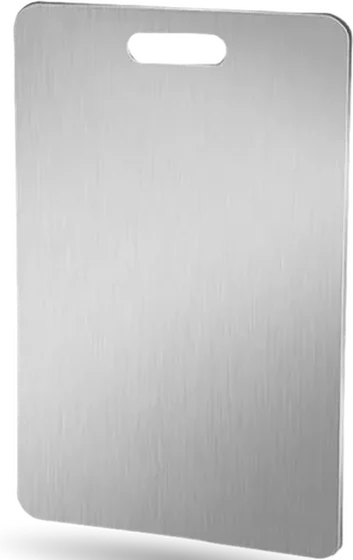
Katori
A double-sided titanium cutting board
- Format
- Titanium cutting board
- Price
- $35.90–$59.00 per board
- Guarantee
- 30-day returns from delivery
- Sold at
- Official website only
In this article
- What Is the Katori Titanium Cutting Board?
- Katori Specs at a Glance
- How It's Made, According to the Seller
- What Katori Says the Board Does
- What Independent Testing Shows About Titanium Boards
- How to Clean and Care for Katori
- Katori Price and Packages
- Katori Guarantee and Returns
- Who Katori Suits, and Who Might Prefer Wood or Plastic
- Katori Pros and Cons
- Katori FAQ
- Bottom Line
The Katori titanium cutting board is a compact, double-sided metal board sold online as a cleaner alternative to wood and plastic. The seller says it is pure titanium, resists stains and odors, needs no oiling and is gentle on knives. In this Katori cutting board review, we cover what the board is, what independent testing of titanium boards has found and who it makes sense for.
We did not test the Katori board ourselves. This review is based on the official product, checkout and policy pages, published tests of other titanium boards and food safety research. Our editorial policy explains how we work.
Key takeaways
- Katori is a double-sided titanium cutting board, 11.4 x 7.9 inches (29 x 20 cm).
- The seller says it is 99.89% pure titanium, made without BPA, heat-resistant and dishwasher-safe.
- It resists stains and odors, needs no oiling and has no plastic to shed microplastics.
- Independent tests of other titanium boards found they dull knives much faster than wood, plastic or rubber.
- At the time of writing, one board costs $59.00, less per board in packs of 2 to 4, plus shipping from $4.95.
- Change-of-mind returns within 30 days must be unused and in the original packaging.
What Is the Katori Titanium Cutting Board?
Katori is a thin, flat metal cutting board with a brushed finish and a cut-out handle. Both faces are usable, which the seller presents as a way to keep raw and cooked foods apart. It is sold through the official Katori website.
At 11.4 x 7.9 inches (29 x 20 cm), it's a small-to-medium board: fine for slicing fruit, cheese or a cooked steak, but tight for breaking down a whole chicken. The seller also pitches it for camping because it is light and tough.
Katori Specs at a Glance
| Feature | What the seller lists |
|---|---|
| Material | "100% pure titanium"; a product image says 99.89% pure titanium |
| How it's made | Laser-cut titanium |
| Size | 11.4 x 7.9 in (29 x 20 cm) |
| Design | Double-sided, with a cut-out handle |
| Surface | Non-porous; resists scratches, dents, warping, stains and odors |
| Heat | Heat-resistant; hot pots and pans can go directly on it |
| Cleaning | Warm water and mild soap, then dry with a soft cloth; listed as dishwasher-safe |
| Other | Made without BPA; no oiling needed |
| Thickness and weight | Not published |
How It's Made, According to the Seller
The seller describes Katori as laser-cut from pure titanium. One product image states "99.89% pure titanium" and shows excerpts of lab reports from SGS, a testing company, that appear to cover metal composition and food-contact tests, including extractable heavy metals. We could only see cropped images, not the full reports, so we can't confirm what was tested or on which batch.
Why this matters: not every board sold as titanium is titanium. When America's Test Kitchen (ATK) calculated the density of three "titanium" boards from their weight and size, two turned out to be stainless steel (ATK, 2026). Katori was not part of that test. If the material matters to you, ask support for the full lab report, and note the weight when the board arrives. Titanium is much less dense than steel (Royal Society of Chemistry), so a true titanium board feels light for its size.
What Katori Says the Board Does
According to the official site, the Katori board:
- Has a non-porous, antibacterial surface where bacteria "can't get trapped inside"
- Resists odors and stains from foods like onion and garlic
- Is "knife-friendly," keeping blades sharper than glass or ceramic boards
- Resists scratches, dents and warping, and is "built to last a lifetime"
- Can hold hot pots and pans
- Is made without BPA or plastic, so it sheds no microplastics
- Lets you keep raw and cooked foods on separate sides
Some of these points are well supported for titanium. Others are not, or depend on how you use the board.
What Independent Testing Shows About Titanium Boards
Knife Wear
This is the biggest question with any metal board. Two recent hands-on tests of titanium boards (not Katori) found heavy knife wear:
- America's Test Kitchen cut parsley, onion, squash and tomatoes on five metal boards and measured knife sharpness before and after. Every metal board dulled the knife dramatically, titanium and stainless steel were equally hard on edges, and the same knife on a wooden board stayed close to new (ATK, 2026).
- Prudent Reviews dulled knives with 300 rocking cuts and 300 straight chops on each of 10 boards. Titanium was the worst, with an average sharpness loss of 444 points on a BESS tester, versus 65 for polypropylene plastic and 15 for end-grain walnut (Prudent Reviews, 2026).
The Rational Kitchen reached the same verdict: safe for food, hard on knives (The Rational Kitchen, 2025). The reason isn't that titanium is harder than knife steel. A rigid metal surface has no give, so the thin edge rolls over or flattens each time it strikes the board (ATK, 2026).
Katori's own FAQ frames its knife-friendly promise as a comparison with glass and ceramic, which are also very hard on edges. Next to wood, plastic or rubber, expect to hone and sharpen more often.
Hygiene, Stains and Odors
Here, titanium does well. In Prudent Reviews' test, garlic, beets and chipotle peppers left no stains or odors on titanium after washing, while the wooden boards held a garlic smell.
"Antibacterial" is a bigger promise. We found no published test showing that Katori's surface kills bacteria. A non-porous board is easy to clean, but it still needs a hot, soapy wash after raw meat, poultry or fish (University of Maine Cooperative Extension). Other materials hold up well too: in a lab test for ATK, wood, plastic, bamboo and composite boards were all cleared of salmonella by hot soapy water, a bleach solution or vinegar (ATK, 2026). Plastic mainly becomes hard to clean once it has deep knife scars (Ak et al., 1994).
Food Contact and Microplastics
A titanium board has no plastic in it, so it can't add microplastics to food, unlike polyethylene and polypropylene boards, which release measurable particles during chopping (Yadav et al., 2023).
Titanium has no known biological role, is considered non-toxic and resists corrosion, which is why it's used in hip joints and dental implants (Royal Society of Chemistry). One caveat: knives still scratch metal. ATK saw scratches on every metal board, the worst on titanium, and its science editor noted that each scratch means microscopic metal shavings coming off the board (ATK, 2026). Nobody has measured how much that adds up to.
Noise, Grip and Handling
Metal boards are loud. In Prudent Reviews' sound test, chopping on titanium measured 80.6 dBA, versus 67.6 dBA on edge-grain maple. Testers at both outlets also found thin metal boards slid around without a damp towel or non-slip mat underneath. Katori's product photos show a flat sheet with no feet or rubber grip, so plan on a damp cloth under it.
How to Clean and Care for Katori
The seller's care directions are simple:
- Wash with warm water and mild dish soap after each use.
- Dry right away with a soft cloth to avoid water spots.
- Skip abrasive cleaners and scouring pads, which can damage the surface.
The site also lists the board as dishwasher-safe and says it never needs oiling. If you cut raw meat on one side, wash the whole board before flipping it: both faces rest on the counter in turn, so "raw side, cooked side" only works if you clean in between.
Katori Price and Packages
At the time of writing, the official checkout lists these one-time prices, shown in U.S. dollars:
| Package | Price per board |
|---|---|
| 1 board | $59.00 |
| 2 boards | $49.99 each |
| 3 boards | $45.95 each |
| 4 boards | $35.90 each |
Shipping and handling start at $4.95 and are calculated at checkout. We saw no subscription option; an extended warranty add-on may be offered and is optional. Prices can change, so check the official site for current pricing.
Orders are usually processed within 24 hours. Delivery estimates after dispatch: United States, 2 to 12 business days; United Kingdom and Europe (including Ireland), 7 to 12; Canada, 8 to 12; Australia and New Zealand, 8 to 14. International orders may owe local customs duties.
Katori Guarantee and Returns
Katori offers a 30-day return window, counted from the day you receive your order. According to the returns policy:
- Damaged, defective or wrong item: Katori will arrange a replacement or a full refund. Report transit damage within 48 hours of delivery, with photos.
- Change of mind: the board must be unused, undamaged and in its original packaging.
- Process: email support first with your name, order number and reason. If approved (usually within 3 business days), you get a return authorization (RMA) and the return address. Don't ship anything before approval.
- Costs and timing: you pay return shipping, and original shipping isn't refunded. Inspection takes up to 7 days; refunds then take about 3 to 5 business days.
Good to know
The "unused" rule matters. If you cut food on the board to see whether you like it, a change-of-mind return may not qualify. Ask support how they handle a lightly used board before your first cut: support@get-katori.com or +1 (910) 981-1790.
Who Katori Suits, and Who Might Prefer Wood or Plastic
Katori makes the most sense if you want a board with no plastic and no oiling, mostly slice, serve or prep raw meat rather than chop hard, like the idea of a dishwasher-safe board, or need a light, tough board for camping or grilling.
You may be happier with wood, plastic or rubber if you do a lot of heavy chopping, own good knives you'd rather sharpen less often, want a large work surface or dislike the clatter of a knife on metal.
A common setup is a good wooden board for most chopping plus a separate non-porous board for raw meat. Our guide to titanium cutting boards and the best cutting board materials compares the options in detail.
Katori Pros and Cons
Pros
- No plastic, so no microplastics from the board
- Non-porous: no stains or lingering odors
- No oiling; listed as dishwasher-safe
- Double-sided, with a handle; light enough to take outdoors
- Clear per-board pricing and a one-time purchase
- Seller shows lab report excerpts for titanium purity
Cons
- Titanium boards dulled knives much faster than wood, plastic or rubber in independent tests
- Loud, and can slide without a damp cloth underneath
- Compact size limits big jobs
- Thickness and weight not published
- Change-of-mind returns must be unused; you pay return shipping
Katori FAQ
Is the Katori cutting board really titanium?
The seller says it is pure titanium and shows lab report images stating 99.89% purity. We couldn't review the full reports. Titanium is much less dense than steel, so a true titanium board feels light for its size.
Will the Katori board dull my knives?
Katori says its surface is gentler on knives than glass or ceramic. Independent tests of other titanium boards found they dull knives much faster than wood, plastic or rubber, so plan to hone and sharpen more often.
Is a titanium cutting board safe for food?
Titanium is considered non-toxic and is used in medical implants. The board has no plastic to shed, and its non-porous surface is easy to wash. Like any board, it needs a hot, soapy wash after raw meat, poultry or fish.
Is Katori dishwasher-safe?
The seller lists it as dishwasher-safe. Its care instructions also suggest a wash with warm water and mild soap, then drying right away with a soft cloth to avoid water spots.
What size is the Katori cutting board?
11.4 x 7.9 inches (29 x 20 cm). The thickness and weight are not published.
How much does Katori cost?
At the time of writing, $59.00 for one board, $49.99 each for 2, $45.95 each for 3 and $35.90 each for 4, plus shipping from $4.95.
Can I return Katori?
Yes, within 30 days of delivery. Damaged or defective boards can be replaced or refunded. Change-of-mind returns must be unused, in the original packaging and approved first, and you pay return shipping.
Where can I buy Katori?
Through its official website, where the seller's 30-day return policy and support cover your order.
Bottom Line
The Katori titanium cutting board delivers on what a metal board does well: no plastic, no stains or odors, no oiling and quick cleanup. Its weak spot is the one every metal board shares. Independent tests found titanium boards are hard on knife edges, noisy and prone to sliding.
It's a reasonable pick as a second board for raw meat, serving, slicing or camping, especially if microplastics are your main concern. If you chop a lot or own knives you care about, keep a wooden board for the heavy work. Read our titanium cutting board guide or browse more in Healthy Kitchen.
References
- America's Test Kitchen. Why We Don't Recommend Metal Cutting Boards. America's Test Kitchen, 2026. link
- Palermo A. Titanium and Stainless Steel Cutting Boards Review (Pros, Cons, Test Results). Prudent Reviews, 2026. link
- The Rational Kitchen. Titanium Cutting Boards: A Bad Fad. The Rational Kitchen, 2025. link
- Royal Society of Chemistry. Titanium: Element information, properties and uses. Periodic Table. link
- Evrendilek GA. Bulletin #3108, Safe Cutting Boards: Materials, Usage, and Cleaning Tips. University of Maine Cooperative Extension. link
- Yadav H, Khan MRH, Quadir M, et al. Cutting Boards: An Overlooked Source of Microplastics in Human Food? Environmental Science & Technology, 2023. link
- Ak NO, Cliver DO, Kaspar CW. Decontamination of Plastic and Wooden Cutting Boards for Kitchen Use. Journal of Food Protection, 1994. link